A lot of household budgets share a recurring failure mode. The month looks balanced — income covers fixed costs, groceries fit the budget, a little discretionary money is left over — and then a large bill that was entirely foreseeable lands and gets filed, with a straight face, as an "unexpected expense." Car insurance, six months at once. Holiday spending. A vet visit. None of these are genuinely surprises. All of them break the budget every time.
Sinking funds fix most of this category. They are simple, and there is nothing clever about them, but they are quietly one of the single biggest improvements a household can make to how its money runs.
What a sinking fund actually is
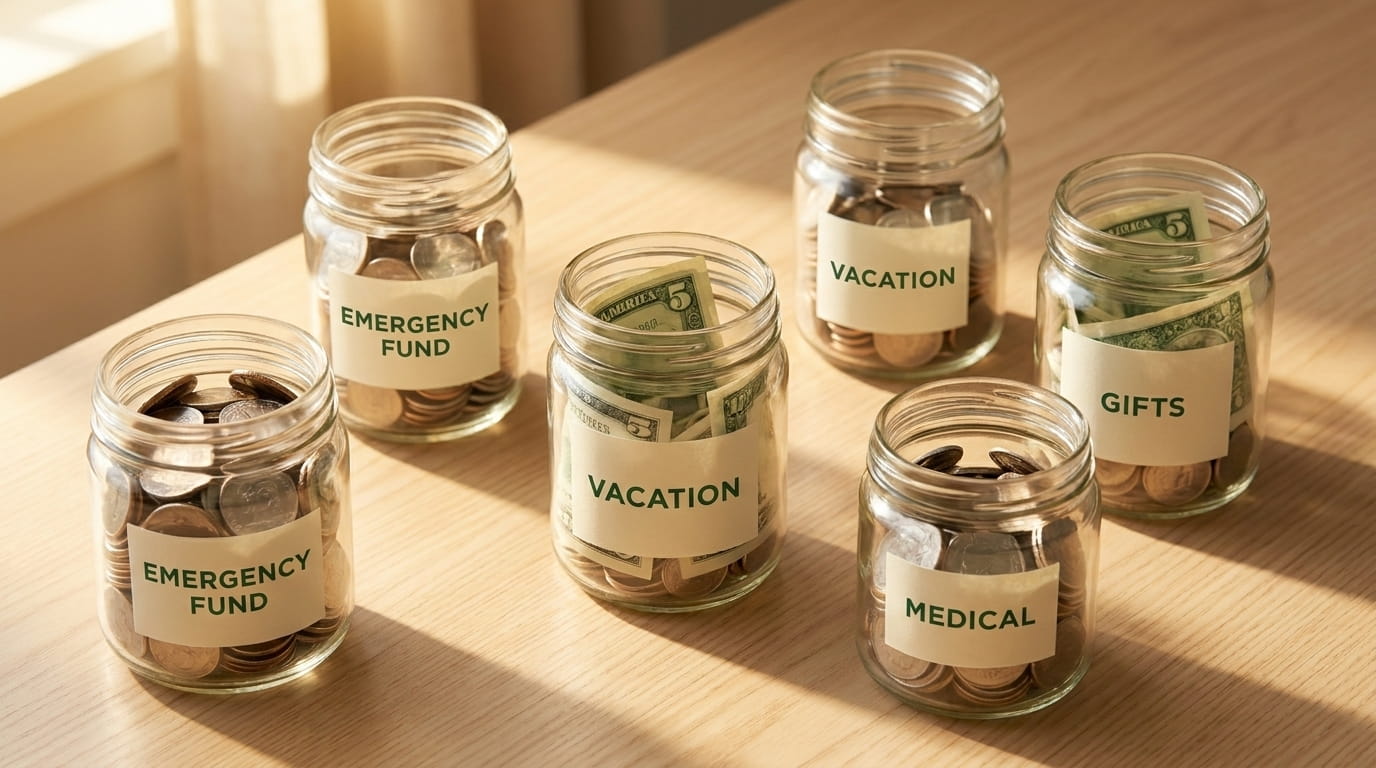
A sinking fund is a small, named savings pot you fill in advance to cover a known irregular expense. The name comes from corporate finance, where a "sinking fund" is money set aside to repay a bond at maturity. The household version is the same idea: predictable obligation, slow accumulation, no panic at the deadline.
The trick — and "trick" is too strong a word — is to treat the irregular expense the way you would treat rent: a monthly line item, paid into a holding account, available when the bill arrives.
A sample set of six
Here is an illustrative set for a household with a car and a pet, with annual amounts:
| Sinking fund | Annual | Monthly |
|---|---|---|
| Car insurance (6-month policy × 2) | $1,820 | $152 |
| Christmas & birthdays | $1,400 | $117 |
| Annual subscriptions (Prime, Notion, etc.) | $540 | $45 |
| Vet & pet care | $900 | $75 |
| Car maintenance & tires | $1,200 | $100 |
| Travel home (flights, two trips/year) | $1,800 | $150 |
| Total | $7,660 | $639 |
Some of these are firm — the insurance bill arrives twice a year for a known amount. Some are estimates — pet care, in particular, might run about $600 in a good year and $1,400 in a bad one. The point is not to be precisely right; it is to be in the right neighborhood.
You do not need a sinking fund for things that genuinely cannot be predicted. You need one for things you have decided to pretend you cannot predict.
How to size them
For genuinely recurring expenses (insurance, subscriptions), use last year's actual cost. For variable ones, take the average of the last three years and round up by 10–15%. For categories where the bill could be huge (vet visits, dental work), set the monthly contribution at the higher end of the historical range and let the fund grow a buffer over time. A pet sinking fund that has not been touched in eighteen months is not "wasted" — it is doing its job by existing.
Where to keep them
One high-yield savings account, sub-divided. Some banks (Ally, Capital One 360) let you create named savings "buckets" or "envelopes" inside one account; if yours does, use that feature. If not, a single account plus a spreadsheet column for each fund works fine. Keep it somewhere covered by deposit insurance — the FDIC for banks or the NCUA for credit unions — since this is cash you cannot afford to lose.
Separate physical accounts for each fund are usually not worth it. The administrative overhead — keeping six accounts in good standing, dealing with login problems, watching for fee changes — is real, and the psychological benefit is small. One account, six named columns, one monthly automatic transfer. Done.
Three small rules
- Automate the transfer. Same day as payday. Money you have to manually move never moves.
- Do not raid one fund for another bill. The vet money is for the vet. If you raid it for Christmas, both funds are now wrong.
- Review every January. Cancel the subscriptions you forgot about. Re-size the categories that drifted. It is a 20-minute exercise.
Run consistently, this system catches essentially every "surprise" a household throws at it. There is one category it should not try to cover: the genuinely unpredictable large repair — a $2,200 boiler failure, say. That belongs to the emergency fund, not a sinking fund of its own. The labor of separating the two pots is what makes both work.