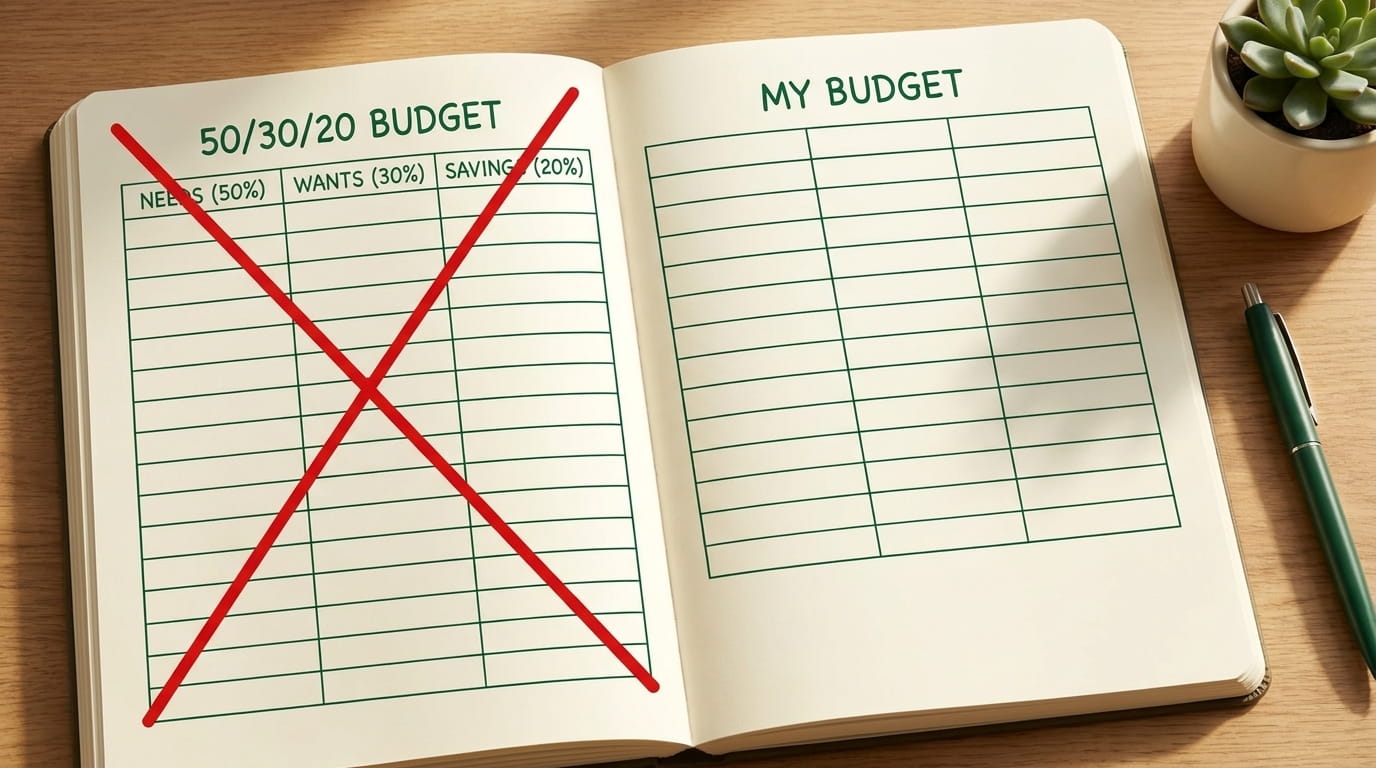
The 50/30/20 rule is the most quoted budgeting framework in personal finance: fifty percent of post-tax income to needs, thirty to wants, twenty to savings and debt. It is a beautifully clean number. It is also, for a lot of households in 2026, hard to reconcile with the actual cost of living in a city.
The rule was popularized by Elizabeth Warren and Amelia Warren Tyagi in All Your Worth, published in 2005. The arithmetic that made it work then has shifted. According to U.S. Bureau of Labor Statistics data, several of the categories the rule files under "needs" — shelter and medical care in particular — have risen faster than average wages across much of the last two decades. The math has moved; the rule has not.
This is not a new budgeting system. It is a small set of corrections to the 50/30/20 frame that keep it usable when "needs" no longer fit in half your paycheck.
Why the rule misses
The big problem is that "needs" has quietly inflated. Rent, health insurance, childcare, and student-loan payments — four of the heaviest line items in most middle-income households — have all outpaced wage growth over the last decade. In many real budgets, those four together consume well over half of post-tax income before a dollar reaches the grocery store. Whatever is left has to do the work of three buckets, not two.
The second problem is that the rule treats "savings" as one category. In practice most people have at least three: short-term savings they might touch this year (a broken washing machine, a flight home), medium-term savings for things one to five years out (a car, a wedding), and retirement, which can't be touched without a tax penalty. Treating them as one number means the short and medium pots are forever being raided to make the percentage look right.
And the third — minor, but real — is that "wants" is moralized. A daily oat-milk latte gets coded as decadent. The same money spent on a warehouse-club membership and a meal-prep Sunday gets coded as virtuous. Both are discretionary; the rule quietly encourages you to lie to yourself about which is which.
Fixed-first accounting
Here is the first correction. Before any percentage hits the spreadsheet, sum every truly fixed expense — rent, utilities, insurance premiums, minimum debt payments, the gym membership you refuse to cancel — and subtract it from take-home pay. That number is no longer the input to a budget. It is a fact.
What is left is the only money you actually get to budget. Everything that follows applies to that smaller pile.
This sounds obvious. It is also the step the rule skips. The 50/30/20 framing implies you have control over the 50; in many 2026 budgets, 35–45 of that 50 is already committed before the month starts.
The thing the 50/30/20 rule actually budgets is the discretionary fraction of your income. Pretending otherwise is how you end up "off-budget" by the eighth.
Four buckets, not three
Then split what is left into four pots, in this order:
- Variable essentials — groceries, household, transit, prescriptions. Things you will spend on regardless, but where the amount fluctuates.
- Sinking funds — the predictable irregular bills (car insurance, holidays, annual subscriptions, "winter coat" money) that always seem to be a "surprise" and never actually are. Sinking funds get a separate piece.
- Future-you — retirement contributions, an emergency-fund top-up if it is below target, debt principal beyond the minimum. The non-negotiable savings work.
- Discretionary — everything else. Travel, restaurants, the occasional decadent thing.
A reasonable split of what's left after fixed expenses is roughly 35 / 15 / 30 / 20 across those four — but these work better read backwards than forwards. Instead of treating them as a hard forward constraint, check at month-end whether the actual spending in each bucket made sense for the month you had.
How to actually track it
For most people, a plain spreadsheet beats a paid budgeting app for this — not because apps are bad, but because the goal is a five-minute weekly check-in and a fifteen-minute monthly review, and apps designed to maximize engagement quietly work against a habit you want to be boring. The friction that matters is whether you open the file at all.
A workable sheet needs only three tabs: an "actuals" page where you paste a CSV export from your bank once a week, a "budget" page that holds your targets, and a "savings" page that tracks the sinking funds and the emergency-fund balance. That is the whole thing.
If you'd rather not build it from scratch, a free copy of this template goes out with the weekly newsletter.
What to take from this
If you take one thing from this piece, take the fixed-first step. Stop trying to budget a number you have already committed to a landlord and an insurer. Budget what is actually yours to allocate.
If you take two things, also split your savings into named buckets. The single biggest unlock in most household finances is admitting that "save 20%" is a fiction, and replacing it with specific dollar targets — one for the appliance that will eventually fail, one for retirement, one for whatever big thing is one to five years out. The math gets easier when the categories tell the truth.
And if you take a third thing, drop the moralizing. Discretionary is discretionary. Track it, set a limit you can live with, and stop apologizing for the latte.