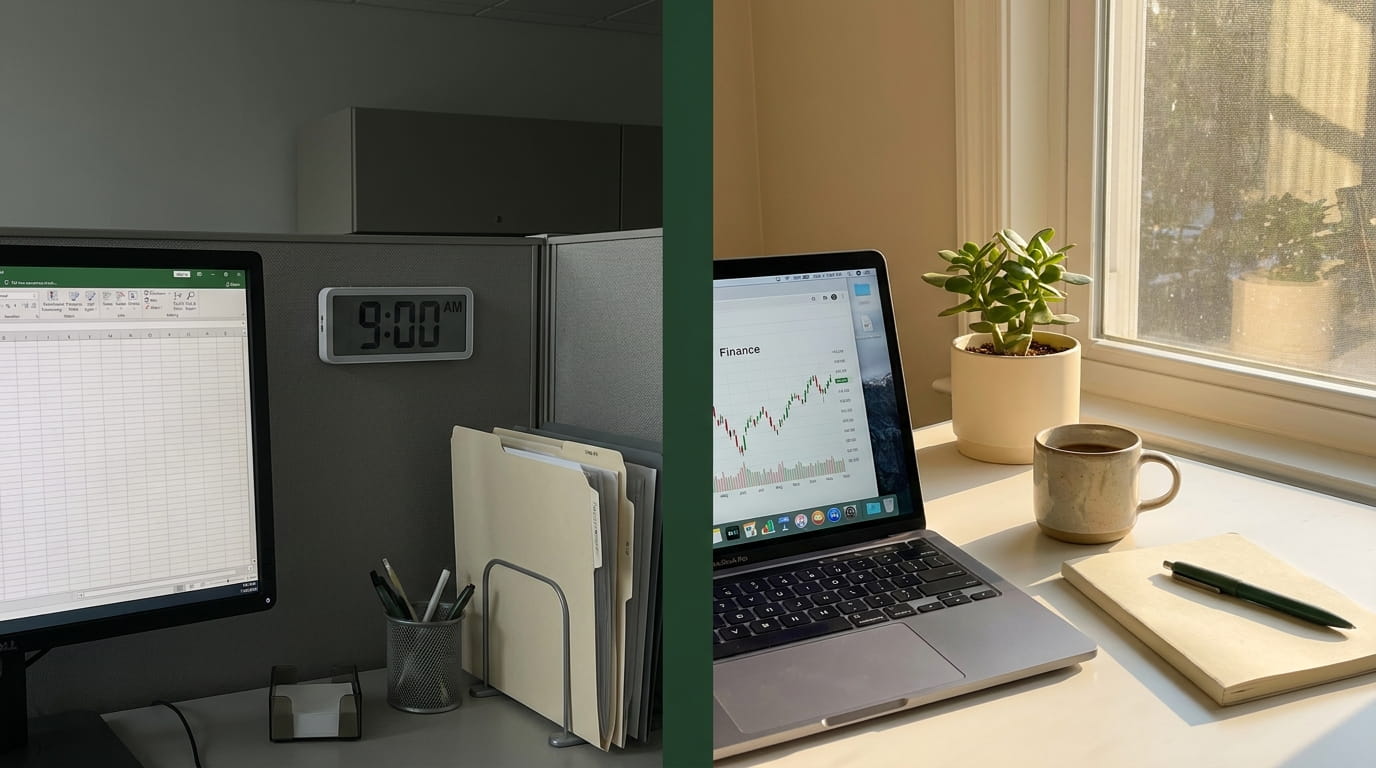

If your first year of freelance income just ended and you have not paid quarterly estimates, opened a separate bank account for the business, or talked to a tax professional, this article is for you. The bill is bigger than most people think, and it is mostly preventable. The dollar figures below are a realistic illustration — a freelancer with a $70,000 day job and $20,000 of side income — but the mistakes are the common ones.
Mistake one: assuming W-2 withholding will cover it
If you have a day job and a side hustle, the day-job paycheck withholds federal and state income tax automatically. Most people, in their first freelance year, assume that withholding is roughly enough.
It is not. W-2 withholding is calculated against your W-2 salary only. The freelance income is, in tax terms, sitting outside the withholding system entirely. If your W-2 salary is $70,000 and you have $20,000 of freelance income, your W-2 withholding will be approximately correct for the $70,000 of W-2 — and you will owe federal income tax, self-employment tax, and probably state income tax on the $20,000 with no withholding at all.
The IRS expects you to pay that tax as you earn it, not at the end of the year. If you do not, you owe interest and possibly an underpayment penalty.
Mistake two: skipping quarterly estimated payments
Freelancers and other self-employed people are expected to make four estimated tax payments a year, due roughly April 15, June 15, September 15, and January 15. They can be calculated using the IRS Form 1040-ES worksheet — the math is not complicated — or by using the "safe harbor" rule: if you pay at least 100% of last year's tax (110% if your AGI was over $150,000) across the four quarterly estimates, the IRS will not impose an underpayment penalty.
A freelancer who makes no quarterly payments in year one and then files the following April commonly owes something like $4,200 of federal income tax on the side income, $1,840 of self-employment tax, and a few hundred dollars of underpayment penalty. The penalty is the smallest piece but also the most avoidable.
Mistake three: under-tracking deductible expenses
Self-employed income is taxed on net profit, not gross revenue. That means every legitimate business expense — software, home-office portion of rent, professional fees, mileage, equipment, courses, a share of phone bills — reduces the taxable income, as the IRS small-business and self-employed center details. A freelancer who does not track expenses systematically can easily miss $3,000 or more of deductions, which at a typical marginal rate costs hundreds of dollars in unnecessary tax.
The list of things freelancers commonly miss:
- Home office deduction. If you use part of your home regularly and exclusively for the business, you can deduct a share of rent, utilities, and internet — either via the simplified method ($5/square foot, up to 300 square feet) or the actual-expense method.
- Health insurance premiums. Self-employed health insurance premiums are deductible above-the-line, reducing both income tax and self-employment tax. If you pay $680/month for a marketplace plan, that is $8,160/year of deduction many first-year freelancers forget.
- Retirement contributions. A SEP-IRA or Solo 401(k) lets you contribute pre-tax dollars that reduce self-employment income. Worth thousands per year for higher earners.
- Mileage. If you drive to client meetings or to interview sources, the standard mileage rate (67¢/mile in 2026) adds up faster than most freelancers track.
- The 199A "qualified business income" deduction. A 20% deduction on qualified business income, subject to income thresholds. Apply through your tax software — most platforms handle it automatically if you flag the income type correctly.
A first-year freelancer who does not deduct anything is paying tax on the gross. The IRS expects you to pay tax on the net. The difference is yours to claim.
Mistake four: forgetting self-employment tax exists
As the quitting-the-job piece covers in more depth: on net self-employment income, you owe 15.3% to Social Security and Medicare in addition to income tax. On $20,000 of net SE income, that is roughly $2,825 of extra tax that has nothing to do with your income-tax bracket.
You can deduct half of SE tax against income tax, which softens the blow somewhat. You cannot avoid the underlying payment. Most first-year freelancers learn this in April of year two, in the form of a number they were not expecting.
A system that works, in one paragraph
The setup that prevents all four mistakes is simple. Keep one freelance bank account separate from personal. Every payment from a client hits it; every business expense comes out of it. The first thing that happens to a deposit is that 30% of it gets transferred to a "tax savings" account at the same bank — high yield, untouched. Quarterly, pay the IRS and the state from the tax-savings account using the IRS's online direct-pay system. At year-end, export the business account's transactions to a CSV and hand it to a CPA. The whole system takes about three hours a month and is among the best dollar-per-hour-saved processes in a freelancer's financial life.
If you take one thing from this article, take the 30% rule. Move 30% of every freelance deposit into a tax-savings account the day it arrives. The money in that account is not yours; it is the IRS's, currently parked at a high yield. You will hand it back four times a year. Doing this from month one is the cheapest insurance against an April surprise there is.