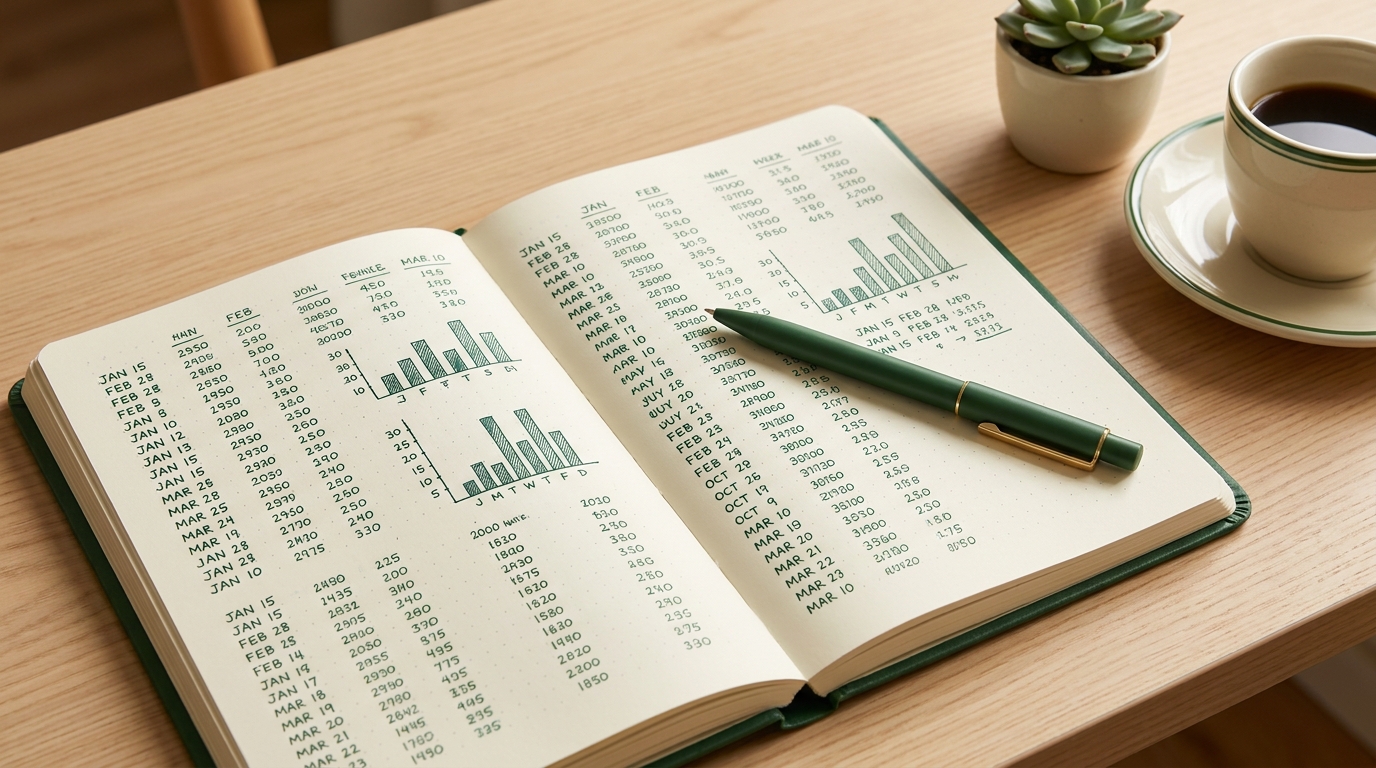
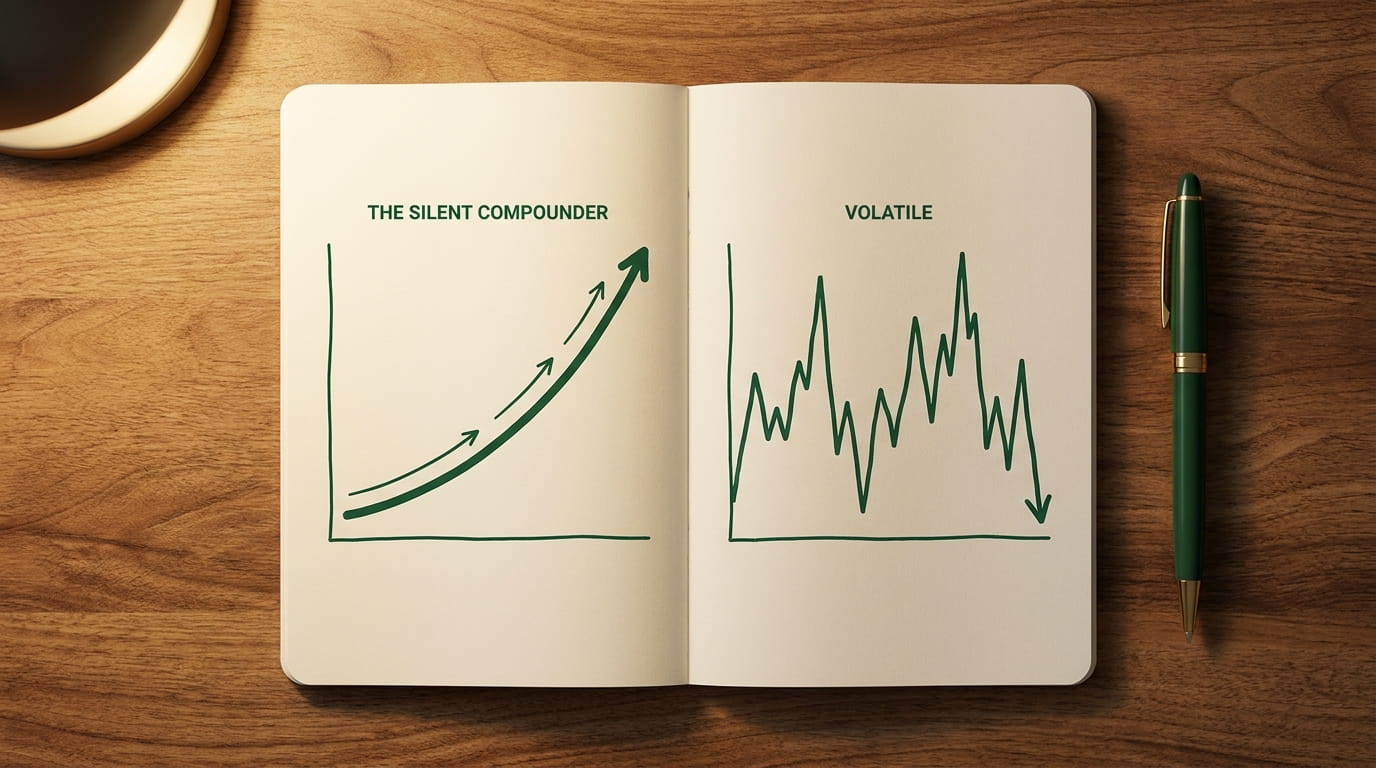
A clean way to see why automatic dividend reinvestment so often wins is to imagine splitting a $20,000 starter portfolio in half. One half — call it Portfolio A — goes into a single broad-market index ETF (VTI), with dividends set to automatically reinvest. The other half — Portfolio B — is the "active" sleeve: individual dividend-paying stocks, each held at least a year, with dividends reinvested manually into the names you most want to add to. Keep both halves separate and log each year-end balance.
This is an illustrative experiment, not a controlled study — the sample is one of each, the picks are not randomized, and the two halves drift apart partly for market reasons. But run forward eight years, the gap is wider than most people expect, and the reasons matter.
The experiment, briefly
Portfolio A: $10,000 into VTI. An automatic monthly contribution of $250 added through July 2024, then paused. Dividends reinvested mechanically. Total contributions over the period: $19,750.
Portfolio B: $10,000 split across five individual dividend names. Same $250 monthly contribution, allocated to whichever name looks most attractive that month. Dividends paid in cash and reinvested manually, sometimes into the position that paid them, sometimes into a different name. Same $19,750 of contributions.
Same broker, same start date, same tax treatment, same external macro environment. Different process. The SEC's Investor.gov makes the same general point about low-cost index investing and the drag of frequent trading.
What tends to happen
| Metric | Portfolio A (index, DRIP) | Portfolio B (active picks) |
|---|---|---|
| Total contributed | $19,750 | $19,750 |
| Value at Dec 31, 2025 | $36,840 | $30,720 |
| Total return | +87% | +56% |
| Decisions made (8 years) | ~12 (rebalancing only) | ~190 |
The numbers above are pre-tax. Post-tax the gap narrows slightly — the active sleeve has higher turnover and more capital-gains realizations along the way — but Portfolio A still wins by enough that the explanation cannot be tax timing.
Notably, even within Portfolio B, the names added mechanically — bought as part of an automatic dollar-cost-average schedule — tend to outperform the names "researched and chosen." In this example, the mechanical subset of B does roughly +73%, while the truly active subset does about +44%. The active half of the active sleeve loses to the index by a wide margin.
Why the boring side wins
Three reasons, in order of magnitude.
Concentration penalty. Portfolio B holds five to seven names at any given time. Even with reasonable picks, if one of those names drops 60% and never recovers, it dents the whole sleeve. The same drop, in a portfolio of 4,000 names, would be a rounding error.
Behavioral drift. Across roughly 190 manual decisions, an investor will make a handful of bad ones — selling into a panic that bounces back, holding past a fundamental change. It does not take unusual indiscipline; the sheer count of decisions is the problem. The index half makes about twelve.
Automated reinvestment is mechanical and fast. Every dollar of dividend gets reinvested at the next-available price. In Portfolio B, dividends accumulate as cash and get batched — sometimes sitting for weeks while the investor decides which name to add to. Those weeks are drag.
The hardest argument against an active strategy is not that it underperforms. It is that the underperformance is mostly your own fault, and you cannot stop being yourself.
The cost that gets underestimated
The big number is the return. The small number is the hours spent. Over eight years, conservatively, managing Portfolio B takes around 200 hours — reading 10-Ks, monitoring earnings, deciding when to buy or trim. Over the same period Portfolio A takes maybe fifteen hours, mostly the annual rebalance.
Value that time at even $40/hour and the gap widens by another $8,000 of opportunity cost. Portfolio B underperforms by $6,120 in raw terms and consumes $8,000 of time to do it.
What this implies
The practical conclusion is to let the split die. Close the active sleeve, fold the survivors into the index position, and let everything drift toward index-shaped — something like 80% broad-market index funds (VTI and VXUS) and 20% in a handful of long-held individual names whose sale would trigger a capital-gains event not worth paying.
None of this means you cannot read 10-Ks or follow individual companies. It means not trying to outperform an index with taxable money you cannot afford to manage badly. The experiment, run on paper, teaches the same lesson tuition would.
One small footnote about reinvestment. The single switch that matters most across Portfolio A's life is the default to "reinvest dividends." Every broker offers this; you tick a box once. It is the closest thing to free outperformance available to a retail investor over a multi-decade window. If your dividends are sitting as cash in a brokerage account right now, tick the box this week.